
 Trade W
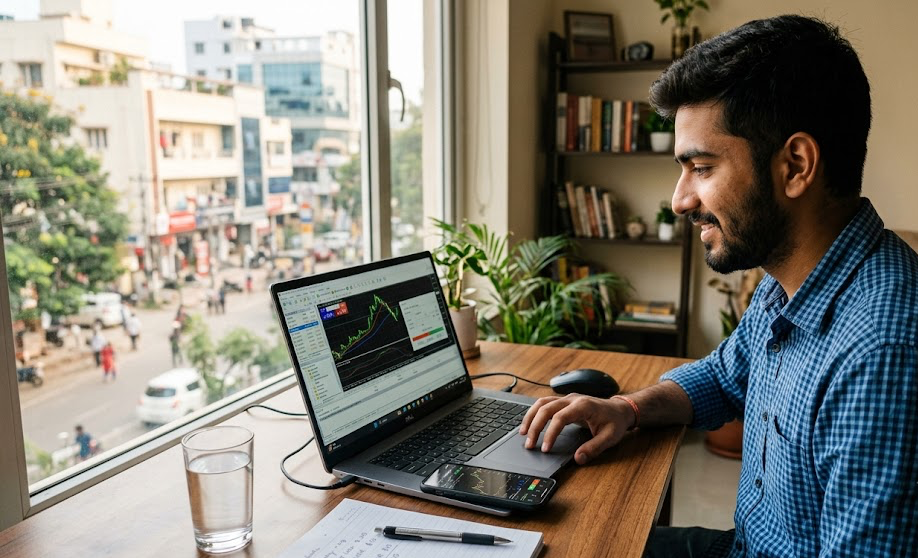
There are a number of brokerages located outside India that may offer low-cost mini dollar trading accounts. While this may appeal to many traders in India, it is important to understand that any forex trading account, regardless of its form, should only be opened with brokers that are registered with SEBI, operate on SEBI-approved exchanges, and offer currency derivatives listed on those exchanges. Therefore, instead of focusing solely on finding the lowest-cost mini dollar trading account from an overseas broker, prospective traders should first understand the applicable legal framework and practice using a demo account.
4 Ways to Safely Start Trading in India
-
Understand the basic terminology of forex trading, including currency pairs, leverage, margin, and pip value.
-
Understand the applicable rules and regulations by using only SEBI-approved brokers, trading only on recognized exchanges, and trading only the seven currency pairs permitted in India.
-
Verify that a broker is properly registered by checking the SEBI Intermediary Portal and the RBI Alert List.
-
Before using real funds, practice with a demo account.
Starting Forex in India on a Small Budget
It is easy to understand why people are attracted to a $10 forex trading account. If you are new to trading, you probably do not want to risk a significant amount of money while you are still learning, and micro accounts offered by some brokers appear to provide a low-risk way to get started. Every year, millions of first-time and mobile-first traders in India look for this type of account, and the continued growth of mobile trading apps has made this option seem more accessible than ever.
However, accessible does not necessarily mean legal under India's forex regulations. The Reserve Bank of India has consistently warned the public about using offshore platforms that offer forex trading services to Indian residents. For example, the RBI Alert List has included more than 88 entities that are not authorized to provide forex trading services, based on recent figures. The RBI has also made it clear that the absence of a platform from the Alert List does not mean that it has been approved or authorized.
Rather than focusing on the easiest platform to sign up with or the one requiring the lowest minimum deposit, this guide explains the legal framework for forex trading in India first. It provides a clear understanding of what offshore $10 trading accounts actually are and outlines the safest practical approach for beginners who want to learn forex trading in India. Think of this guide as a resource that recognizes the challenges of starting with limited capital while emphasizing the importance of understanding the legal framework governing forex trading in India.
Is Forex Trading Legal in India? The Rules You Must Know First
The following information was not included in any of the $10 broker articles. Beginners who choose to use a broker that is not registered with SEBI risk dealing with an unauthorized broker and exposing themselves to significant financial losses.
Understanding India's regulatory framework is essential before making any decision about entering the forex market. From this point forward, the decisions you make should be based on a clear understanding of this framework.
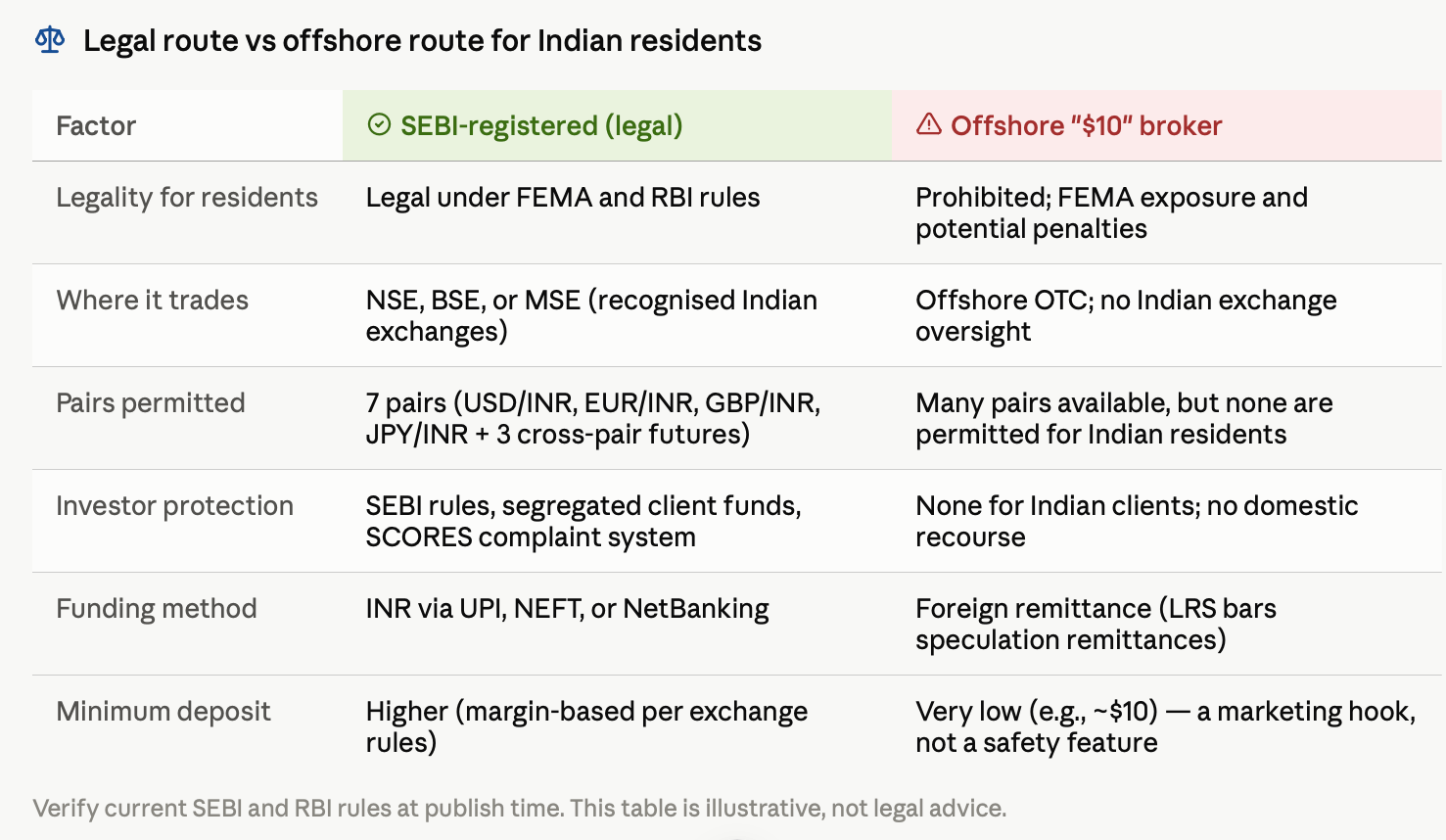
SEBI (Securities and Exchange Board of India) is responsible for regulating brokers and market intermediaries in India. If a broker is not registered with SEBI, it is not authorized to solicit Indian clients for forex trading.
RBI (Reserve Bank of India) regulates currency and foreign exchange policy under the Foreign Exchange Management Act (FEMA). Under the Liberalised Remittance Scheme, Indian residents are prohibited from remitting money outside India for speculative foreign exchange trading or margin trading.
FEMA (Foreign Exchange Management Act) governs foreign exchange transactions in India. Violations of FEMA can result in penalties of up to three times the amount involved or ₹2 lakh, whichever is greater. In serious cases, the Enforcement Directorate may freeze bank accounts or initiate legal proceedings in addition to imposing financial penalties.
What Indian residents can legally trade:
To trade currencies in India, residents can only transact through brokerage firms that are registered with SEBI and operate on recognized exchanges such as the NSE, BSE, or MSE. The only approved method of trading is through exchange-traded currency derivatives, including futures and options, rather than spot forex or CFDs. There are seven approved currency pairs available for trading. The four INR pairs are USD/INR, EUR/INR, GBP/INR, and JPY/INR. The three cross currency pairs are EUR/USD, GBP/USD, and USD/JPY.
If you would like to learn more about currency derivatives in a broader context, the Forex Derivatives guide explains the structure and functionality of currency derivatives in detail. If you want to understand how cross currency pairs work specifically, please refer to the cross-currency pairs trading guide for a comprehensive explanation.
Can You Really Start Forex With $10? What "$10 Brokers" Actually Are
There is no SEBI-registered broker that allows you to start trading with a $10 deposit. The reason is that trading exchange-traded currency derivatives requires an initial margin deposit, which is calculated using the SPAN margining algorithm. In most cases, the required margin will be significantly higher than $10. As a result, any broker advertising a $10 minimum deposit for forex trading is typically an offshore broker operating under a foreign regulatory authority, such as the FSA Seychelles, the FCA in the United Kingdom, or ASIC in Australia.
This does not necessarily mean that these brokers are fraudulent. However, they are not authorized to offer offshore forex trading services to Indian residents under the applicable regulatory framework. Trading with such brokers may also expose beginner traders to additional legal and financial risks that they may not fully understand or anticipate.
What a micro account or cent account actually means:
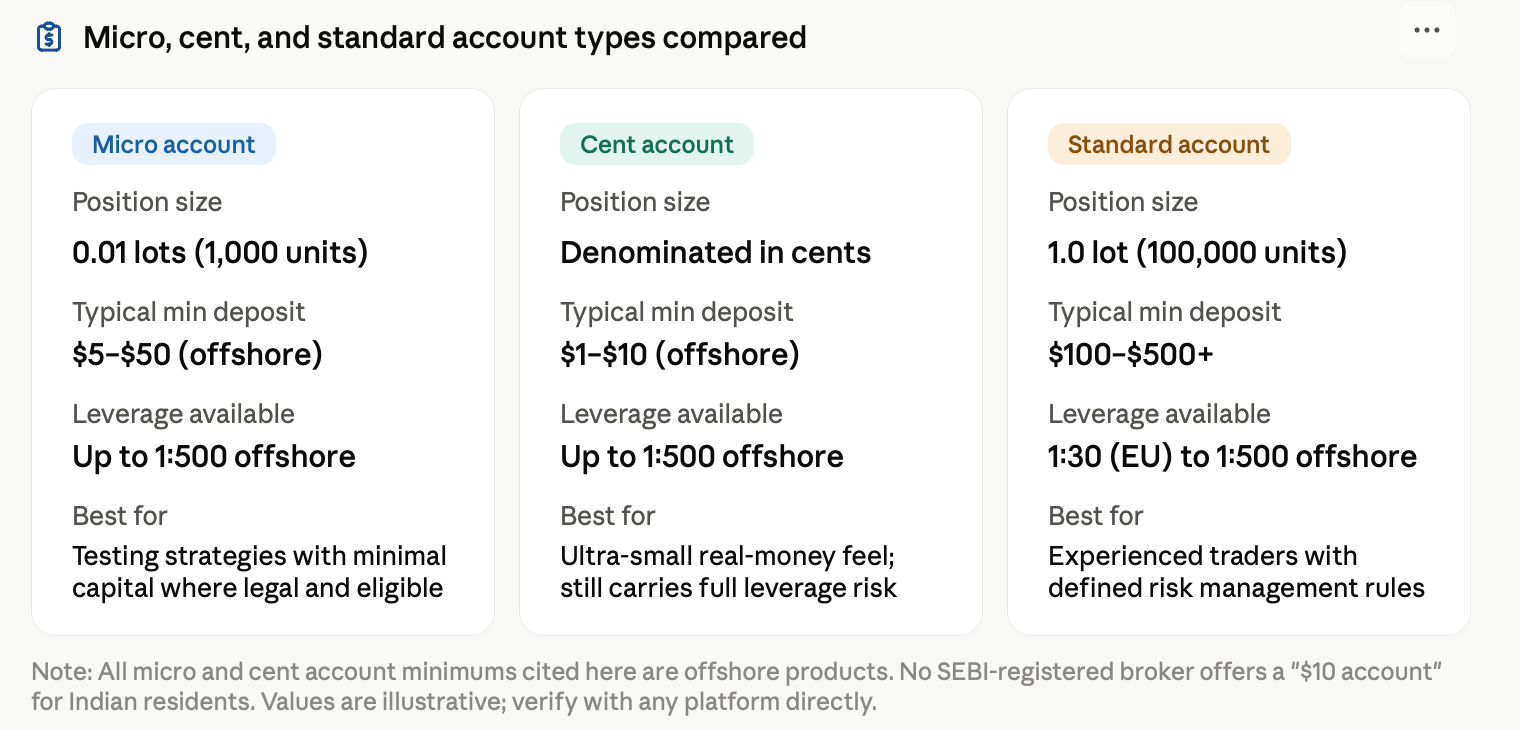
Micro accounts allow traders to trade micro lots, which are equal to one-hundredth of a standard lot. Cent accounts keep the account balance denominated in cents rather than dollars, meaning that a $10 deposit appears as a balance of 1,000 cents, allowing traders to place much smaller nominal trades. While micro and cent accounts reduce the dollar amount involved in each trade, they do not reduce the leverage applied to the position or the percentage of your account that is at risk on each trade.
For example, if you trade with an offshore broker offering leverage of up to 1:500 on a $10 micro account, even a small adverse market movement can quickly result in the loss of your entire account balance if your position is highly leveraged. This is not an effective way to learn how to trade. Instead, it resembles speculation with very little margin for error, while the spread and other trading costs create a negative expected outcome before the trade has an opportunity to become profitable.
What a $10 budget is actually good for:
For the example discussed in this article, if your total trading capital is genuinely limited to $10, the most effective starting point is not to deposit it immediately. A free demo account allows you to experience the same market conditions, real-time price feeds, charting tools, and order execution mechanics as a live account, but without risking any capital while you learn the fundamentals of trading. Spending two full months practicing on a demo account will teach you far more than losing your $10 deposit during the same period through spread costs and mistakes that are common in the early stages of learning to trade. Understanding how central banks drive currency market movements will make those demo sessions significantly more productive from day one.
How to Choose a Beginner-Friendly Broker Safely
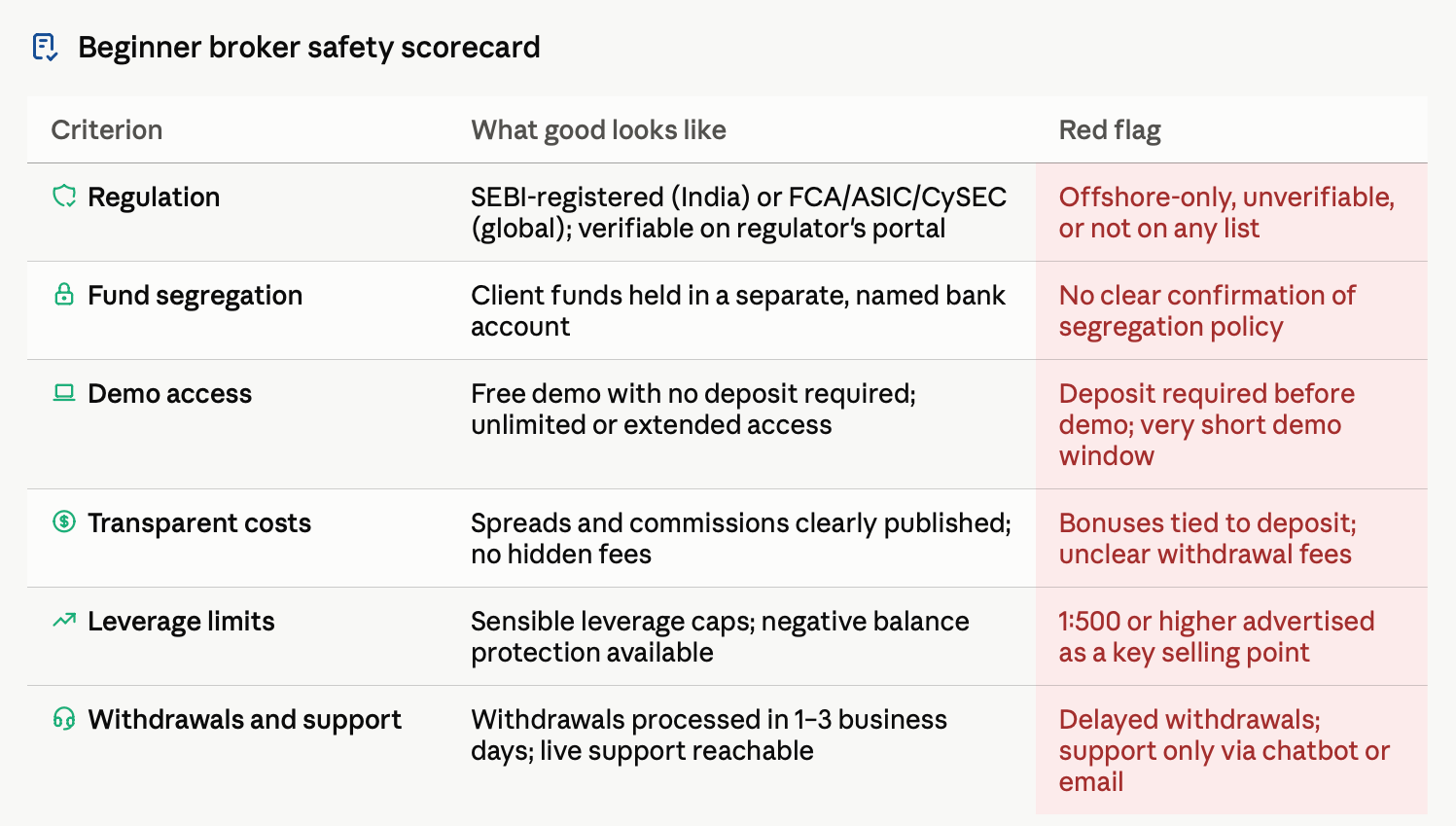
When choosing a reputable broker, both global users and Indian traders should evaluate the same core factors: regulation, fund protection, demo account availability, and trading costs.
1. Verify the Broker's Regulation and Registration
For Indian residents, the first step is to verify that the broker is registered with SEBI as an intermediary authorized to offer exchange-traded currency derivatives. It is also important to cross-check the RBI Alert List before depositing any funds. For brokers operating outside India, look for tier-one regulators such as the FCA (UK), ASIC (Australia), or CySEC (Cyprus and the European Union), all of which impose strong capital adequacy and client fund protection requirements.
2. Verify Fund Safety and Segregation
Ensure that client funds are held in segregated accounts that are separate from the broker's operating funds. This means your money cannot be used to satisfy the broker's liabilities if the firm becomes insolvent. If a broker cannot clearly confirm that client funds are held in segregated accounts, it should not be considered.
3. Test the Demo Account First
A reputable broker should provide access to a demo account without requiring an initial deposit. If you must deposit funds before accessing the demo account, treat this as a warning sign. A quality demo account should closely replicate the live trading environment, allowing you to evaluate execution speed, charting tools, and available order types without risking real capital.
4. Evaluate the True Cost of Trading
Spreads and commissions together determine the cost of executing a trade. A broker advertising zero commissions may instead incorporate its fees into the spread. For this reason, compare the total cost per trade across multiple brokers rather than focusing on a single advertised feature. For less experienced traders, choosing a broker with lower maximum leverage may also help reduce the speed at which trading losses can accumulate.
5. Test Withdrawals Before Committing
Before making a substantial deposit, request a small withdrawal early in your relationship with the broker. This allows you to evaluate how quickly withdrawals are processed and how responsive customer support is if any issues arise. This firsthand experience provides a more reliable assessment of the broker than marketing claims alone. You should also consider reviewing the carry trade interest rate differential guide, as it provides useful context for understanding how overnight financing costs may affect the overall trading expenses charged by different brokers.
Risk Management for Beginners With Small Accounts
Many novice traders think of risk management as something they can focus on after they have made money from trading. In reality, the opposite is true. Risk management should be your highest priority when trading with limited capital and learning how to become a successful trader.
Risk Management Rule: The 1-2% Rule Explained
The maximum loss on any single trade should generally be limited to 1-2% of your total account balance. For example, with a $200 account, the maximum risk per trade would be between $2 and $4. Although this may seem like a very small amount, limiting risk on every trade is one of the key differences between traders who remain in the market long enough to develop their skills and those who lose their entire account within a few weeks. The objective during the early stages of trading is not to maximize profits but to build discipline, preserve capital, and develop consistent trading habits. If your goal is to strengthen discipline from one trading session to the next, the currency correlation and hedging guide can provide a useful framework for developing structured risk management practices.
Why Does High Leverage Create Excessive Risk for Traders with Small Accounts?
High leverage may appear attractive because it increases the potential for larger profits. However, it also magnifies losses by the same proportion. For example, at a leverage ratio of 1:500, a market movement of just 0.2% against a fully leveraged position can result in the loss of your entire deposit. In practice, there is a significant probability that the market will move against your position by that amount before moving in your favor. Once trading costs such as spreads are included at both entry and exit, the probability of achieving consistent success becomes even lower, particularly for inexperienced traders.
The retail loss reality you should know before depositing anything:
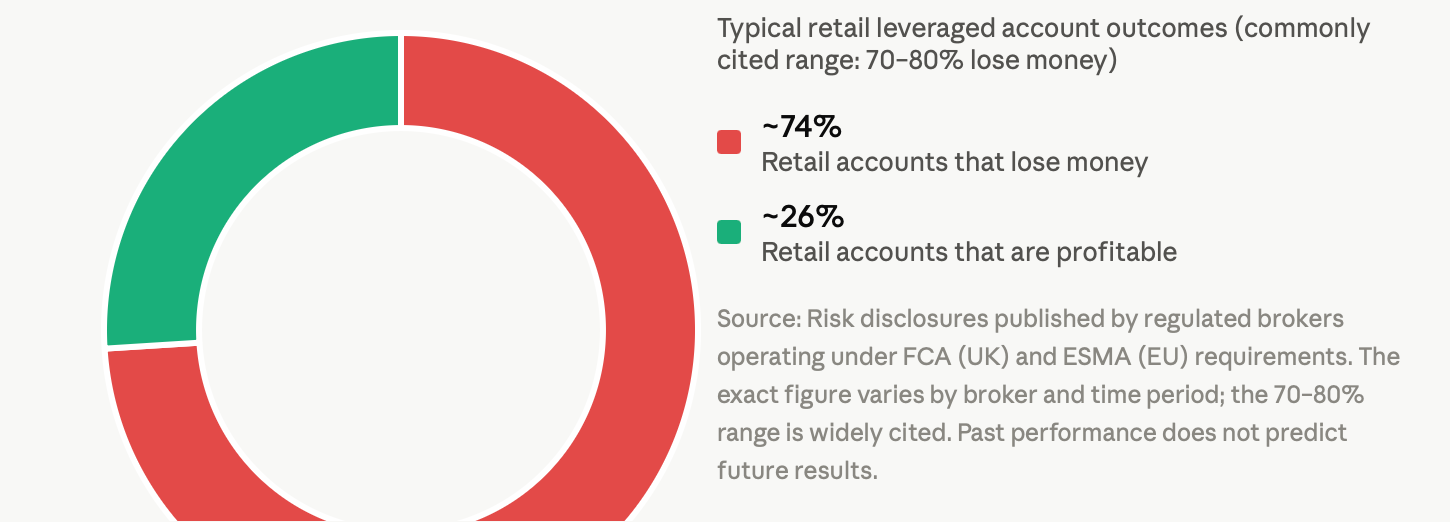
Overview of the Statistics: The purpose of these statistics is not to discourage you from learning to trade, but to help you understand the level of preparation required before entering the forex market. Before risking real money, most financially successful traders spend a considerable amount of time developing their skills, testing trading strategies, and practicing risk management, often by using demo accounts. During the early stages of your trading journey, the primary objective should be to develop your skills, preserve your capital, and gain experience, rather than trying to generate significant profits from a small trading account.
Where Tradewill Fits: An Honest Assessment
Tradewill is an offshore broker regulated by the FSA Seychelles under license SD111. It is not registered with SEBI and, therefore, is not authorized to provide forex trading services that comply with the regulatory framework applicable to Indian residents under FEMA. If you are an Indian resident seeking to trade forex through legal channels, you should use a broker that is registered with SEBI and operates on a recognized exchange such as the NSE, BSE, or MSE.
Despite Tradewill's regulatory status with respect to Indian residents, its free demo account can still serve as a useful educational tool. The platform allows users to practice trading without risking real money, and no deposit is required to open a demo account. This provides beginners with an opportunity to learn how the MT4 trading platform works, understand currency pair charts, and practice placing and managing trades in a simulated market environment before committing any real capital.
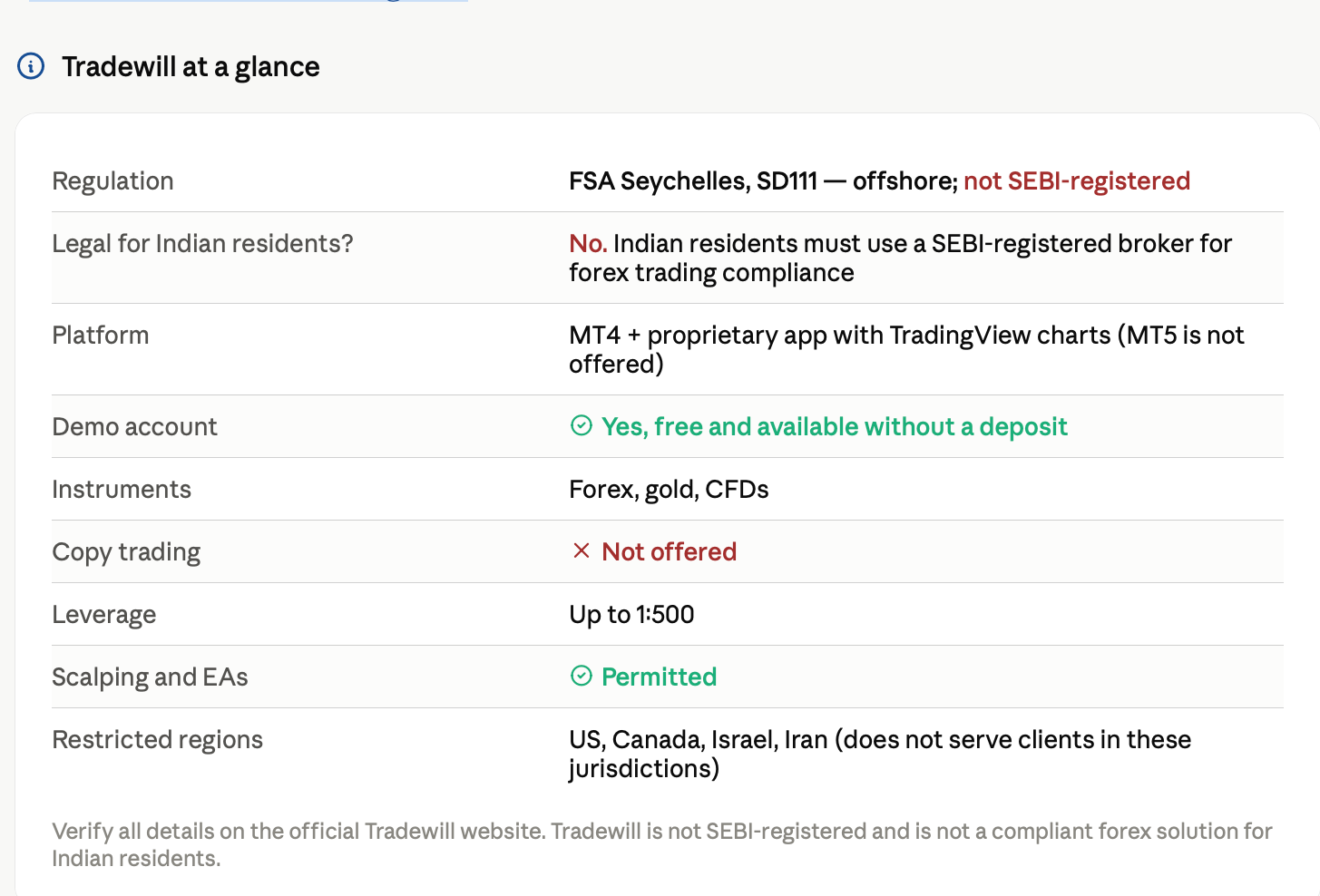
Individuals outside India who are eligible to open a live trading account may benefit from Tradewill's low-cost access to the MetaTrader 4 (MT4) trading platform. Before opening a live account, all prospective clients should review the regulatory framework that applies in their country of residence to ensure they are permitted to use the platform.
Regardless of where you live, opening a free demo account is recommended as the first step in learning to trade. Eligible users in jurisdictions where Tradewill accepts clients may consider using the platform to explore its features and practice with a demo account before deciding whether to open a live trading account.
Frequently Asked Questions
Can I start forex trading with $10?
Some offshore brokers will accept a $10 deposit, but for Indian residents this route conflicts directly with FEMA and the RBI's remittance rules. With only $10, the most practical and legally safe option is practising on a free demo account, which teaches you the same skills without any real money at risk and without any regulatory exposure.
Is forex trading legal in India?
Forex is legal in India only through SEBI-registered brokers on recognised exchanges, and only in seven permitted currency pairs traded as exchange-listed derivatives. Spot forex and CFDs via offshore brokers are prohibited under FEMA and can carry penalties reaching three times the transacted amount or ₹2 lakh.
What currency pairs can Indian residents legally trade?
Indian residents can legally trade USD/INR, EUR/INR, GBP/INR, and JPY/INR as exchange-traded futures and options, plus the cross-currency futures EUR/USD, GBP/USD, and USD/JPY. All trading must go through SEBI-registered brokers on Indian exchanges. Reading about GBP/USD trading mechanics can help you understand how one of those permitted cross-pairs behaves before you start.
What is a micro account in forex trading?
A micro account lets you trade in micro lots of 0.01 standard lots, which reduces the nominal capital required per trade. It's marketed to beginners and small budgets. While it lowers the dollar value at risk per position, it doesn't remove market risk and it doesn't change the fact that offshore micro accounts are not a compliant route for Indian residents.
Are low-deposit offshore brokers safe for Indian traders?
A very low minimum deposit is primarily a marketing feature, not a safety indicator. Offshore brokers offer no investor protection for Indian clients, and using them may violate FEMA. Withdrawal difficulties, extreme leverage, and a total absence of domestic recourse are all well-documented risks. Verifying a broker's regulation before depositing is always the right first step, regardless of the deposit size.
How do I verify if a broker is legal in India?
Check the broker's SEBI registration on the official SEBI Intermediaries Portal, confirm it operates on a recognised exchange, and cross-check the RBI Alert List of unauthorised platforms. Not appearing on the Alert List does not mean a broker is approved for Indian use; the absence of an entry is not a clearance.
What happens if I use an offshore forex broker in India?
Using offshore platforms for forex trading can breach FEMA and the RBI's LRS restrictions. Penalties can reach three times the transacted amount, and more serious cases can involve Enforcement Directorate action and bank account freezes. You also lose all Indian investor protections and have no domestic recourse if something goes wrong with the platform.
Is Tradewill SEBI-registered?
No. Tradewill is an offshore broker regulated by the FSA Seychelles, not SEBI. For Indian residents, the compliant path to forex trading runs through a SEBI-registered broker. Tradewill does offer a free demo account that anyone can use for learning purposes without any deposit.
Can beginners actually make money trading forex?
Some do, but the majority of retail leveraged accounts lose money, particularly at the beginning. Beginners significantly improve their odds by learning the theory thoroughly first, practising extensively on a demo, managing risk with a defined maximum loss per trade, and treating the early phase as skill development rather than a way to generate income.
What's the safest way for a beginner in India to start forex?
Learn the basics, understand India's legal framework through SEBI and RBI guidance, practise on a free demo account, verify any broker on the SEBI portal and the RBI Alert List, and then start small through the legal exchange-traded route. Prioritising compliance and education ahead of any deposit protects both your money and your legal standing. Understanding concepts like VWAP and volume analysis during your demo period will also give you a meaningful edge before you go live.
Conclusion: The Smart Way for Beginners in India to Start
The search for a $10 forex broker really combines two questions into one: How little capital do I actually need? How can I start without making a financially devastating mistake? The answer to both questions is essentially the same. For an Indian resident, the legal minimum requirement to trade is not a specific dollar amount. Instead, it is using a SEBI-registered broker, trading exchange-traded currency derivatives, and developing the knowledge required to trade them responsibly.
One of the riskiest first steps a new trader can take is opening a $10 offshore trading account. The risk is not the small deposit itself, but the fact that trading through an unauthorized offshore broker may not comply with the applicable regulatory framework in India. In addition, if a dispute arises with an offshore broker, your legal protections and available remedies may be significantly more limited than those available through authorized domestic market participants. A more practical first step is to open a free demo account, which has no cost, no financial risk, and allows you to learn the same platform mechanics, chart analysis, and order execution you would experience with a small live account, without exposing your capital while you are still learning.
This article is provided for educational purposes only and does not constitute financial, legal, or tax advice. Trading foreign exchange and other leveraged financial products involves a substantial risk of loss, and many retail trading accounts lose money. Before making any trading decisions, verify the applicable regulatory requirements with SEBI and the RBI, and consult a SEBI-registered broker or another qualified professional for advice specific to your individual circumstances.
Open a free Tradewill demo account and start learning forex without committing a single dollar to the market, because building the right habits before you trade live is the decision that actually pays off.
Disclaimer: The content of the blog does not represent any position of Trade W, does not serve as any trading-related decision advice, and does not endorse any third-party.